Keith Jarrett Live at San Francisco's War Memorial Opera House
(March 25, 2006)I first saw Keith Jarrett perform with a quartet at the Jazz Workshop in Boston
in the early 1970s. At that time, having been introduced a few years back
to jazz through Bitches Brew, I was interested in seeing performers who
had played with Miles, and Keith filled that bill. I remember, in particular,
his playing a small wooden xylophone. Years later, living in Kyoto, Japan,
I borrowed several of the ECM solo records from Jonah, a theater student
and fellow English teacher. I remember being rather ambivalent about these.
Something about the compositions often strikes me as technically astonishing
but emotionally cold. Later on, the two-disk Spirits (1986), on which
Jarrett plays all instruments, became a favorite recording. Most recently,
I saw a youthful Keith performing in the documentary “Miles Electric.”
After an incredible career, which included “Koln,” his best-selling
live solo concert recording, Jarrett contracted chronic fatigue syndrome
(which he battled from 1996 to 1998), and his performing schedule has
been trimmed for some years. The San Francisco concert is one of only
two solo shows he will perform this year, his first here in a decade and
his first at the War Memorial Opera House in 25 years.
An older, thinner, graying but still spry Jarrett takes the stage at around
8:10 PM. There are to be no late admissions to the concert, but there’s
nary a free seat to be seen. Jarrett, wearing an elaborately embroidered
gold and green vest along with a burgundy shirt that appears, at the distance
at least, to be silk, takes the stage; he stands with his hands pressed
together in a South Asian spiritual salute, a gesture he repeats numerous
times throughout the concert.
Jarrett’s music is complex and impossible to describe. Texturally,
the sound is layered. Jarrett can be all over the keyboard within a small
space of time. At one point he is
playing the notes on either side of the keyboard with both arms outstretched.
At other times he is jumping up from his stool. At times he stands up.
Often, he moans softly. Sometimes in a more guttural fashion. The first
number, the evening’s longest, clocks in at around 20 minutes. Four
more shorter numbers, one a ballad, and it’s time for the break.
And the piano tuner. Tonight’s concert is being recorded.
Commencing again at around 9:15, Jarrett stands in front of the microphone
and announces “I could complain about the government in general...
[General applause and laughter breaks out]... but I see I don’t
need to say anything.” A black shirt now substitutes for the maroon.
Sitting down at the keyboard, he skillfully applies himself to carving
out a lovely, ethereal ballad with high voicings as he presses his hands
into the keyboard. It’s as if he’s setting off on a journey
as he leads us up and over the amazing walls of sound he constructs with
his fingers. Sometimes, it seems as though he is exorcising musical spirits.
Other times as if he were possessed. Some tunes incorporate a bit of boogie
woogie stride, others employ classical elements.
After a half hour, Jarrett leaves the stage to return for what is to be
five curtain calls (where Jarrett reveals himself) and four actual encores.
In keeping with his reputation for irascibility, he comes out and, stepping
up to the microphone, storms melodramatically. “I’m seeing
lightbulbs going off. You know I’ve spent my whole life trying to
make the world a better place for artists to perform in. I think it’s
really insensitive. To the extent that someone is serious about things,
which is becoming rarer and rarer, I think some respect is due. You souvenir
hunters can leave right now!”
Jarrett concludes the evening with a stellar improvisation of “As
Time Goes By.”
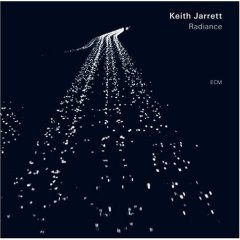 |
| Order Radiance from Amazon |
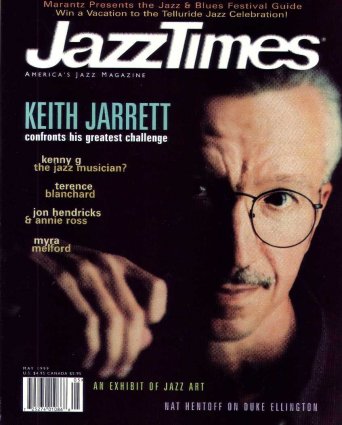
Top: Buy Keith's New Album
Bottom: Jarrett on Cover of JazzTimes, 1999